


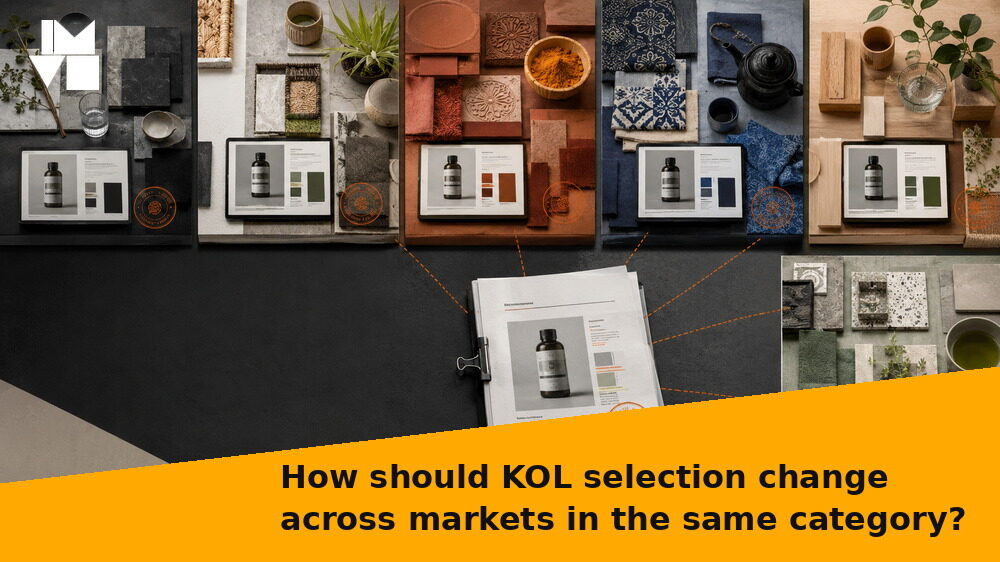
The challenge in selecting KOLs for the same category across multiple markets does not begin with the number of names an agency can contact. It begins with a harder decision: how to preserve a common objective and evidence standard while changing people, roles, platforms, narratives and approval paths by market. Unless that decision is set first, a longer creator list only makes it harder to see who earns attention, who helps an audience understand the product, and who carries enough authority to reduce perceived risk.
The article focuses on work that is often hidden behind the shortlist: assigning roles to objectives, testing evidence, rejecting weak fits and preparing the conditions that make the selection executable. Its subject is selecting KOLs for the same category across multiple markets, not a universal celebrity, influencer, KOL and KOC classification applied to every category.
This article applies the framework for testing whether a large creator network reflects real category expertise to a specific sector. It does not use follower count as a substitute for strategy. It starts with roles, the evidence required for each role, and the work that must still function after the shortlist is approved.
IMVN approaches the problem as a cross-border influencer marketing agency. The job extends beyond booking: the team must understand the category, identify the right people in each market, connect them to the brief and product evidence, then keep usage rights, contracts, payment and reporting aligned with the same selection logic.
A consistent objective does not require an identical shortlist
Before sourcing begins, the brand needs one agreed audience action, the information people must believe, and the errors serious enough to stop publication. In selecting KOLs for the same category across multiple markets, regional consistency does not require five countries to use one list. The team should lock the business problem, buyer group, product facts, brand-safety principles and definition of results. Assumptions about who is trusted, where influence forms and which content persuades must be tested locally.
Before sourcing, the team should answer three questions in writing: what the audience should do, what information they must trust and which error the brand cannot accept. Reach requires a different team from a campaign that must explain features, reduce buyer anxiety, create paid-media material or bring experts into consideration. When objectives are merged, the easiest contacts and quickest quotes tend to dominate.
Team design and budget should therefore follow the difficulty of the decision, not simply the creator count. Differences arise from category maturity, distribution, platforms, language, regulation, seasonality and talent payment practices. Copying the first-market shortlist may save days in sourcing but create weeks of content revisions, replacements or rights issues later. Creator fees are only the visible line; research, samples, trial time, data checks, review rounds, usage rights, tax, documentation and schedule contingencies sit behind it.

Rebuild the influence map in every market
The common failure is treating access as capability. A telephone number or management relationship does not prove fit, availability, product understanding or acceptance of terms. Copying the first market’s shortlist creates three failures: followers without local weight, formats that do not fit viewing habits, and claims that may not transfer legally. Risk rises when the agency does not log rejection reasons, review past content or check active exclusivity.
A useful shortlist shows selected and rejected candidates. Each row should state the campaign role, actual audience, capability evidence, conflicts, price range, rights assumptions and unknowns. Marketing, legal, purchasing and finance can then inspect one decision instead of receiving four different explanations.
The useful question is not what a person calls themselves, but what job they are being hired to do and what evidence shows they can do it. A person with followers in several countries may carry little weight in each one. A format used in Vietnam may not be where Thai buyers ask questions; a credential trusted in Indonesia may require different proof in Korea. Cross-border reach does not by itself prove local influence. A profile should advance only when the team can state the selection rationale, what remains unverified, and the condition that would remove the person from consideration.
Regional teams hold evidence; local teams hold judgement
Follower tiers are not enough. For one category operating across multiple markets, a better structure is: regional teams own objectives, measurement and brand-safety standards; local leads revise the influence map, propose people, check conflicts and own fit; local regulatory locks claims. One person may serve two layers, but the agency should name the role being bought and the deliverable that proves it. A title never replaces a work sample, test or evidence of audience fit.
This avoids paying expert rates for a mainstream creator task or giving a technical explanation to someone whose strength is visual production. Senior management should request a simple talent architecture: the objective for each layer, its backup and the trigger for moving to a deeper specialist.
One person may cover more than one role, but the agency should name the deliverable that proves each role. The regional team holds the job of each role and the evidence standard. Local leads rebuild the influence map and check audience, conflicts, culture, timing and contracting feasibility. Local regulatory owners hold claims, while the central agency keeps a common data source so markets remain comparable. This avoids paying for specialist authority when a capable general creator is enough, while also preventing a visually strong creator from being assigned content that requires genuine technical or professional authority.

For a broader view of role design, compare this approach with how to select creators by travel motivation in tourism promotion. The linked article does not replace category-specific criteria; it helps the team test whether every person in the talent mix adds a distinct contribution instead of repeating the same message.
Localise content, claims, contracts and payment
Selecting the right people does not guarantee a workable campaign. Each market should submit a one-page rationale: selected and rejected candidates, differences from regional assumptions, verified evidence and open points. This turns localisation into a reasoned decision instead of permission to swap names without explanation. The brief must translate product knowledge into clear boundaries and useful prompts while leaving enough room for the creator to make the content credible in their own voice.
Booking sits in the middle of the operation. Research, product onboarding, conflict checks and scope come first. Contracts, samples, briefs, claim approval, production follow-up, post verification, data capture, payment and rights management follow. Without one accountable owner, the gap appears precisely when a problem crosses teams.
Commercial comparison only works when every bidder prices the same conditions. Lock shortlist rounds, replacements, deliverables, duration, rights, exclusivity, payment schedule, tax and post-live support. If ‘included’ has no boundary, purchasing should ask for a split. A lower fee is not a saving when the brand must perform the checks and incident work excluded from scope.
Capability evidence is not limited to successful case studies. Select one recent assignment at random and ask the agency to explain, within confidentiality limits, the shortlist log, brief, changes, approval route and final report. The aim is not to obtain another client’s data; it is to see whether a real process exists and whether the agency can explain variance from plan.
In a multi-market project, the regional team should hold the objective, product evidence, brand-safety standard and definition of success. Local teams should adapt the narrative, platform, release timing, trusted voices and approval path. Shared elements should include product truth, objective, brand safety, data structure and rights principles. Local elements include creators, platforms, context, demonstrations, release timing, disclosure, claim wording, contracts and payment routes. Translating one brief into five languages is not the same as building five executable market plans.
A related implementation guide is available at how to localise an industry influence map for each market. Use it as a working reference, but refresh its assumptions about scope, market, usage rights and payment terms for the current campaign.
Compare results without erasing local signals
Read historical data in context: platform, format, posting date, paid support, product, audience and objective. Median views are more useful than one viral outlier; credible comments are more useful than an engagement rate with no sample check. In narrow sectors, the identity and quality of questions may matter more than total views.
In a multi-market programme, the regional team should lock the mandatory layer and let local teams decide what requires adaptation. Objectives, brand safety, KPI definitions and data standards are usually common. People, platforms, cultural context, publishing calendar and claim review are local. Centralising everything slows the programme; decentralising everything removes comparability.
Measurement should follow the job assigned to each role. Keep common definitions for measures such as qualified views, completion, traffic or leads, while allowing local signals such as question type, saves, consultation requests or behaviour on domestic platforms. A report containing only views rewards the larger market, not necessarily the better execution. Views and engagement still matter, but only alongside audience quality, the questions content generates, reusable content assets and the next action the brand can observe.
A category-capable agency should be comfortable saying when evidence is incomplete and proposing a way to verify it before making a commitment. That is more credible than claiming anyone in the network can take the brief. Judgements, sources and assumptions should be shown together so an approver can distinguish a reasonable hypothesis from a checked fact.
| Decision | Evidence to review | Condition not to ignore |
|---|---|---|
| Objective | regional consistency does not require five countries to use one list. The team should lock the business problem, buyer group, product facts, brand-safety principles and definition of… | Differences arise from category maturity, distribution, platforms, language, regulation, seasonality and talent payment practices. Copying the first-market shortlist may save days in… |
| Role | The regional team holds the job of each role and the evidence standard. Local leads rebuild the influence map and check audience, conflicts, culture, timing and contracting feasibility.… | A person with followers in several countries may carry little weight in each one. A format used in Vietnam may not be where Thai buyers ask questions; a credential trusted in Indonesia may… |
| Capability | Before sourcing, run a market-calibration round: give local leads the same brief and ask for three assumptions that need correction and two missing pieces of evidence. Repeated differences… | Each market should submit a one-page rationale: selected and rejected candidates, differences from regional assumptions, verified evidence and open points. This turns localisation into a… |
| Safety | Shared elements should include product truth, objective, brand safety, data structure and rights principles. Local elements include creators, platforms, context, demonstrations, release… | IMVN can hold one backbone for the brief, role taxonomy, data, rights and reporting while using local teams and partners to build shortlists, negotiate, verify and deliver. A cross-border… |
| Outcome | Keep common definitions for measures such as qualified views, completion, traffic or leads, while allowing local signals such as question type, saves, consultation requests or behaviour on… | A strong multi-market campaign looks consistent in what the brand wants to achieve but need not look identical in faces, formats or stories. Differences should be supported by evidence… |
How IMVN keeps one backbone with local execution
Before requesting final quotations, lock six fields: objective, market, required roles, mandatory evidence, usage rights and stop conditions. Before sourcing, run a market-calibration round: give local leads the same brief and ask for three assumptions that need correction and two missing pieces of evidence. Repeated differences show the regional team which parts of the strategy are not truly universal. Once those fields are clear, purchasing can compare like with like and the agency knows where local judgement is allowed.
Before issuing a purchase order or signing contracts, the team can use this short checklist:
- The desired audience action is stated in one sentence rather than as several equal priorities.
- Every creator or expert has a defined role, relevant evidence and a credible backup.
- Product facts, permitted claims, prohibited inferences and the final approver are documented.
- Samples, trial time, production dates, posting dates and revision rounds are feasible.
- Usage rights specify channels, duration, territory, paid media, editing and image rights.
- The quote separates creator fees, operations, production, rights, tax, documentation and contingency.
- Contracting and payment routes are verified for the creator, management, agency and market.
- Measurement matches the content role and connects to a next action the brand can observe.
IMVN can connect that design to delivery: map the roles, source beyond a pre-existing list, check audience and conflicts, coordinate samples, briefing, review, contracting, payment and reporting. IMVN can hold one backbone for the brief, role taxonomy, data, rights and reporting while using local teams and partners to build shortlists, negotiate, verify and deliver. A cross-border agency creates value only when it enables comparison and protects local judgement at the same time. Companies in the IMVN ecosystem operate in Vietnam, Thailand, the Philippines and Indonesia; for other markets, including Korea, the delivery entity and contracting route must be confirmed before launch.
A campaign is ready for booking when the approver can see the full logic on one page: who performs which job, why the person fits, what remains uncertain, which costs belong to which scope and who decides when the plan changes. A strong multi-market campaign looks consistent in what the brand wants to achieve but need not look identical in faces, formats or stories. Differences should be supported by evidence rather than preference.
Planning a similar creator campaign?
Share your market, category and objective. IMVN will respond with practical recommendations for the next step.
Request campaign advice →