

A route-based campaign playbook for international, regional and Philippines-English brands, agencies and creators entering Vietnam.
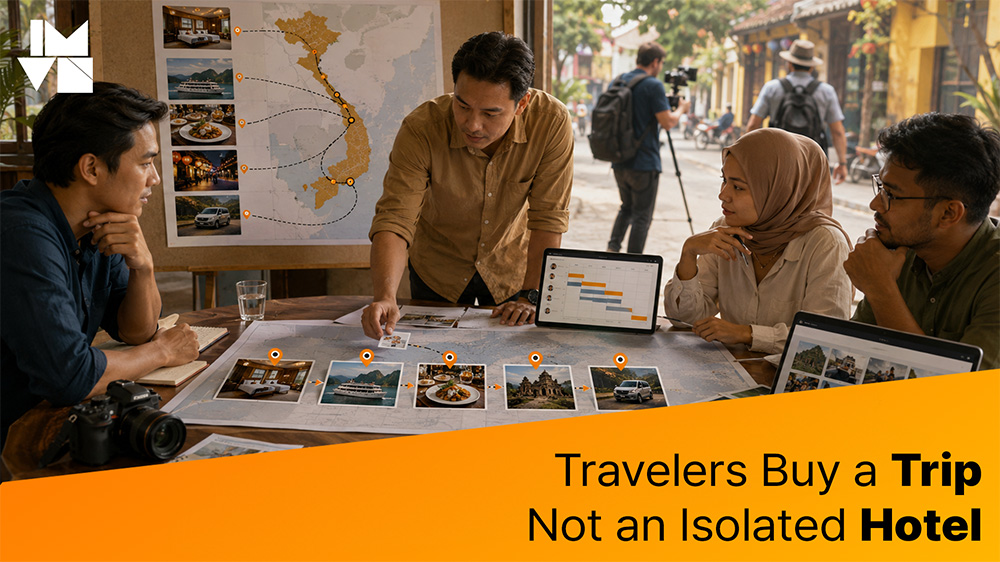
A hotel, cruise, restaurant or attraction naturally sees itself as a standalone product. The traveller sees a connected trip: where to arrive, where to sleep, how to move, what to eat, what to do and whether the total sequence is worth the time and cost.
This difference explains why isolated promotions often create attractive content without enough commercial leverage. A route-based campaign gives each partner a role in a coherent itinerary, enabling richer evidence, shared production and a clearer purchase story.
Travellers buy a connected trip, not isolated suppliers

A traveller rarely begins with “I want to stay at Brand X.” They begin with “I have five days in northern Vietnam—what is the route?” A brand that appears in the right chapter of that answer has a better chance of entering the consideration set.
| Supplier view | Traveller view | Campaign implication |
|---|---|---|
| Sell a room, cabin, meal or ticket | Buy a complete sequence | Standalone content lacks journey context |
| Optimise one brand KPI | Optimise total time, budget and risk | Each partner must justify its route role |
| Maximise individual exposure | Follow a natural story | Spotlight requires governance |
For Philippines-English and other regional audiences, Vietnam content should not remain a list of famous places. Flight gateways, group travel, travel time, contact channels, food and the rhythm of a realistic itinerary determine whether inspiration becomes action.
A strong route needs an anchor, bridges and satellites

A useful route has three layers. The anchor carries established demand and helps the audience recognise the trip. Bridges explain movement and connect chapters. Satellites introduce discovery and allow less-known partners to borrow relevance from the anchor.
| Role | Vietnam examples | Content function |
|---|---|---|
| Anchor | Hanoi, Ho Chi Minh City, Da Nang, Phu Quoc | Entry point, search demand and orientation |
| Bridge | Ha Long cruise, food tour, domestic flight, road transfer | Movement, transition and route logic |
| Satellite | Ninh Binh, Sa Pa, Quy Nhon, craft villages, boutique stays | Discovery and differentiation |
Adding more stops does not automatically create a better route. The sequence needs realistic travel time, distinct partner roles, a coherent audience promise and enough breathing room for experience and production.
Select partners by journey fit
- Audience fit: partners serve a compatible traveller profile and spending level.
- Product fit: offers complement rather than directly cannibalise one another.
- Operational fit: check-in, capacity, seasonality and transport can connect.
- Content fit: each partner contributes a distinct chapter.
- Commercial fit: contribution, deliverables, rights and lead handling are accepted.
- Reputation fit: one weak operation can damage the entire route story.
A co-op trip is not simply a way to split an influencer bill. It is a campaign product with shared governance. Every partner needs clarity on what it receives, what it contributes and where editorial control ends.
Write the route story before the schedule
An itinerary is not a spreadsheet of locations. It needs an opening, progression, high point, recovery and resolution. If each partner demands a complete review, the creator produces a chain of advertisements rather than a useful travel narrative.
| Chapter | Purpose | Possible content |
|---|---|---|
| Arrival | Reduce friction and frame the route | Gateway, transport, first impression |
| Anchor | Deliver the primary reason to follow | City, destination or flagship experience |
| Bridge | Maintain pace and explain movement | Food, transport, cruise or local host |
| Discovery | Create novelty | Satellite destination or hidden experience |
| Resolution | Summarise and enable purchase | Route recap, FAQ and booking options |
Make governance, budget and rights explicit
Budget can be separated into shared route operations, creator/media costs, partner-specific requests and contingency. Equal splitting is rarely fair when one partner requires an additional day, custom production or broader usage rights.
| Cost group | Examples | Allocation logic |
|---|---|---|
| Shared operation | Coordinator, transport, fixer, permits, interpretation | Route-wide or partner count |
| Creator/media | Fee, travel day, editing, whitelisting | Deliverable and audience value |
| Partner-specific | Custom set-up, extra shoot, activation | Paid by the requesting partner |
| Contingency | Weather, changes, cancellation | Shared fund with approval rules |
Contracts should define route-level and partner-level deliverables, approval windows, edit rounds, disclosure, usage, exclusivity, cancellation and what happens if one stop becomes impossible.
A creator trip must run as a production system
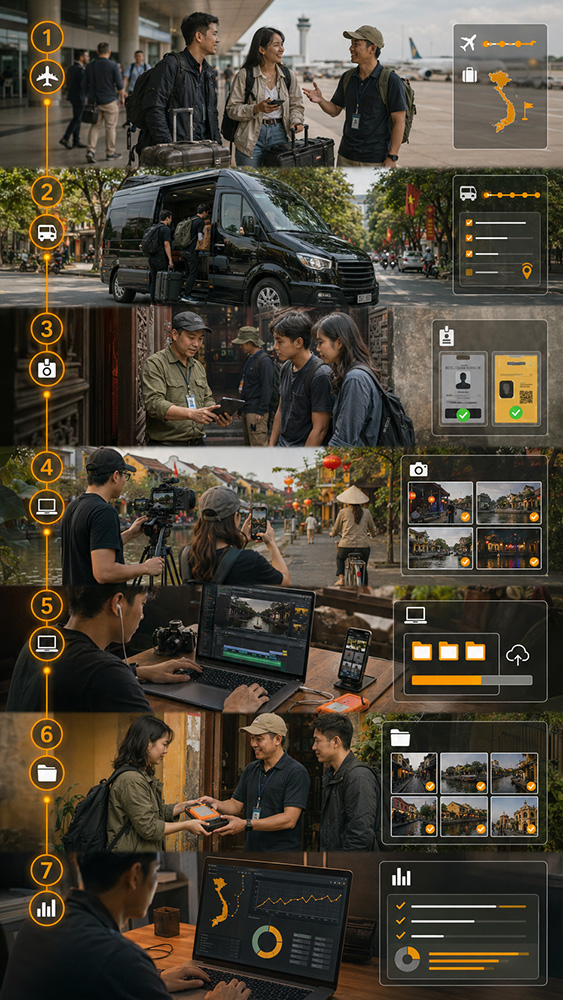
A creator trip can fail through delayed flights, unrealistic transfers, missing permissions, weather, creator fatigue, rooms not being ready, partner presentations running over time or weak file management. Treat the itinerary as a production schedule, not a brochure.
- Add transport buffers and recovery periods.
- Set hard stops for partner activities.
- Prepare weather and access alternatives.
- Prioritise essential shots when time compresses.
- Separate authentic experience time from filming time.
- Give one on-ground lead final decision authority.
- Create backup, naming and asset handoff procedures.
Design deliverables for route and partner value
| Level | Deliverable | Objective |
|---|---|---|
| Route | Hero video, itinerary article, route map | Create demand for the complete trip |
| Partner | Chapter, short clip, photo set, named mention | Build evidence and brand recognition |
| Creator-owned | Posts on creator channels | Reach, trust and community response |
| Brand-owned | Assets with usage rights | Website, paid media and sales |
| Trade | Sales kit, itinerary PDF, approved links | Enable agents and B2B partners |
Equal seconds are not the same as equal value. An anchor may need more narrative time, a satellite may own the surprise moment, and a bridge may make the route understandable and bookable.
Measure at route and partner level
- Route: qualified reach, itinerary saves, route search, total inquiry and cost per qualified traveller.
- Partner: brand search, chapter engagement, click, inquiry, assisted booking and asset reuse.
- Operations: schedule adherence, incidents, travel load, accepted deliverables and partner satisfaction.
- Portfolio: partners to retain, stops to replace and seasons worth repeating.
Cross-border travel decisions rarely follow a clean last-click path. Combine creator data, search behaviour, landing analytics, CRM, partner feedback and post-booking questions.
When a brand should not join a co-op route
- The product or service operation is not stable.
- The brand expects exclusive spotlight while sharing only a fraction of cost.
- The team cannot accept authentic creator interpretation.
- No owner is available for approvals and issue handling.
- Usage rights and disclosure cannot be agreed.
- The route does not match the audience or is operationally exhausting.
Pilot a small Vietnam route
- Select one anchor and no more than three complementary partners.
- Define one audience, route promise and primary KPI.
- Map chapters, timing, spotlight and brand cues.
- Agree governance, budget, rights and cancellation.
- Run a small creator group with distinct roles.
- Review route, partner and operational value before seasonal repetition.
Related reading: Korean content strategy for Vietnam tourism, international KOL strategy for Vietnam tourism, three essentials for international influencer campaigns and destination promotion case study.
Place the route campaign inside the growth system
A route campaign does not replace brand strategy, experience design or local operations. It is the architecture that connects those capabilities into a journey travellers can understand, partners can deliver and teams can measure. Clear ownership prevents the campaign from becoming a familiarisation trip filled with logos but disconnected from commercial outcomes.
| Growth layer | Question to solve | Required output |
|---|---|---|
| Experience design | What is memorable and genuinely worth sharing? | Signature moment, service choreography and experience proof |
| Route architecture | How do the partners become one coherent Vietnam trip? | Anchor, bridges, satellites, route story and partner roles |
| Local operations | Who manages permits, transport, translation, access and disruption? | Runbook, on-ground authority and contingency routes |
| Brand demand | How does content make travellers remember and search for a brand? | Creator portfolio, landing path, search signals, CRM and booking data |
Related IMVN playbooks explain how to design shareable hospitality experiences in Vietnam, why local operation matters in cross-border creator campaigns, and how to move from Vietnam trip inspiration to brand demand. These layers should share one market brief, route promise and measurement model instead of allowing each team to optimise an isolated KPI.
If the experience is weak, the route amplifies an offer that is not ready. If the route is sound but operations fail, creator content records the failure in public. If production performs but the audience has no path into search, agents, CRM or booking, attention does not accumulate into durable brand demand.
Use a Route Readiness Gate before committing budget
Before creators are invited or production dates are locked, the route lead should assess every partner through the same readiness gate. The goal is not to exclude smaller businesses. It is to identify the constraint that could break the whole journey. A small satellite that responds quickly and delivers consistently may be more valuable than a famous anchor with no accountable owner.
- Audience fit: the partner serves a compatible traveller, spending level and season.
- Experience readiness: the real product can repeatedly deliver the campaign promise.
- Operational readiness: capacity, opening hours, access, hard stops and weather alternatives are confirmed.
- Content readiness: shot list, restricted areas, spokesperson and approval timing are agreed.
- Commercial readiness: budget, usage rights, landing path, lead owner and booking process are explicit.
- Data readiness: baseline, tracking method, CRM fields and the post-campaign review calendar exist.
Score each gate as ready, ready with conditions or not ready. The route should commit budget only when there is no blocker involving safety, service capacity, usage rights or final decision authority. Every conditional item needs an owner, deadline and replacement option before production begins.
How IMVN operates a route campaign
IMVN can build the route logic, recruit partners, cook market briefs, select creators, manage local fixers, permits, interpretation, transport, production, rights and reporting. The goal is a route that works in Vietnam’s operating reality and creates useful value for each participating brand.
Sources and responsible forecasting
Market context should be checked against the Vietnam National Authority of Tourism and the route partners’ own capacity, transport, search and sales data. Do not promise revenue using unverified search volume or generic conversion benchmarks.
Planning a similar creator campaign?
Share your market, category and objective. IMVN will respond with practical recommendations for the next step.
Request campaign advice →