


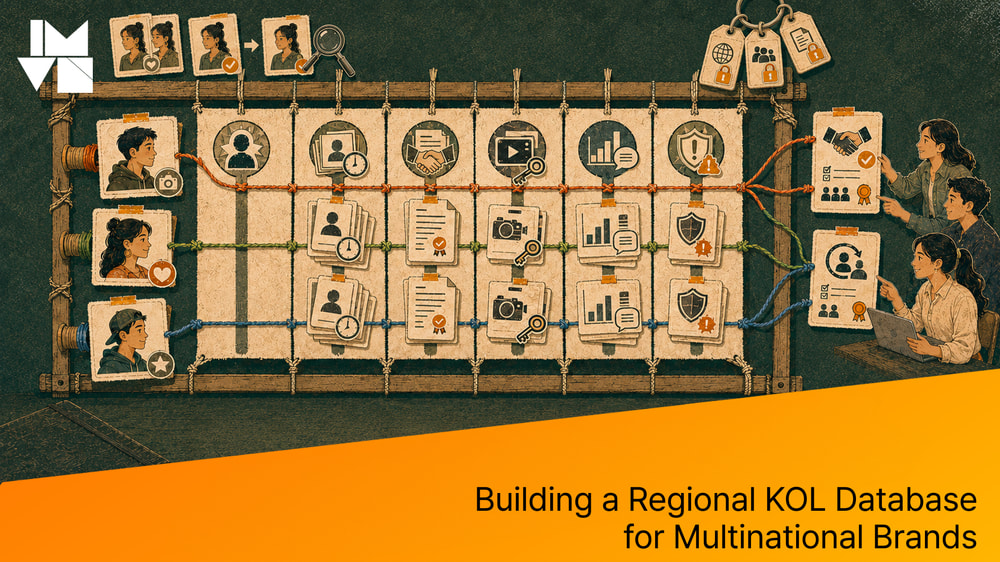
Regional teams rarely lack creator data. They lack the ability to connect records from several agencies, markets and campaign cycles into an auditable history. The same creator can appear under different names, prices can cover different rights, and performance can use different definitions.
Design from regional decisions
The database must answer who can be rebooked, under which role and terms, with what rights, evidence and market-specific conditions. Fields that serve no search, control or decision should not be collected by default.
Use a relational structure
| Table | Primary key | Key fields |
|---|---|---|
| Creator | creator_id | Identity, language, market and representative |
| Channel snapshot | creator_id + channel + date | Followers, median views and source |
| Booking | booking_id | Scope, currency, entity and evidence |
| Deliverable | deliverable_id | Format, deadline, version and rights |
| Performance | deliverable_id + date | Views, valid actions and comment quality |
| Risk/issue | issue_id | Evidence, decision, owner and resolution |
Never overwrite time-based evidence
Today’s follower count should not erase the previous snapshot; a new rate should not replace the scope of an old booking. Dated records allow regional comparison and decision audits.
Update at three control points
- Shortlist: refresh channels, audience evidence, risk and verification date.
- Booking: lock scope, rights, contracting entity and commercial conditions.
- Close-out: add performance, issue history and rebooking decision.
Control access by role
Public channel data, private audience evidence, contracts, payment files and risk notes require different permissions. Regional visibility does not mean unrestricted access.
| Data field | Useful entry | Misleading entry |
|---|---|---|
| Views | Median of 10 recent posts, paid and organic separated | Highest single video |
| Engagement | Substantive comments separated from quick reactions | One total labelled “quality” |
| Audience | Source, capture date and channel scope | A percentage with no date |
| Strong topics | Why audiences respond | “Lifestyle” for everyone |
Store operating and risk data, not only profile data
Record disclosure habits, category conflicts, missed deadlines, revision load, incident history and who verified each field. A high-performing profile can still be expensive to operate or unsuitable for a regulated brief.
Assign ownership for updates
Market teams should own local verification; regional teams should own field definitions and duplicate rules. Every important field needs an updated date and named verifier.
Separate tables instead of forcing everything into one row
Keep creator identity, channel metrics, commercial terms, campaign history and rights in linked tables. This avoids overwriting historical rates or pretending one audience snapshot is permanent.
Use three update triggers so the database stays alive
- Before a Creator enters a new Shortlist
- When a campaign closes and actual delivery is known
- When ownership, audience, rate, risk or contact information changes
The database supports the regional KOL scorecard and gives AI in multi-market KOL management a controlled evidence base.
Start migration with active creator portfolios in priority markets. Prove one real allocation decision before importing thousands of dormant profiles.
Planning a similar creator campaign?
Share your market, category and objective. IMVN will respond with practical recommendations for the next step.
Request campaign advice →