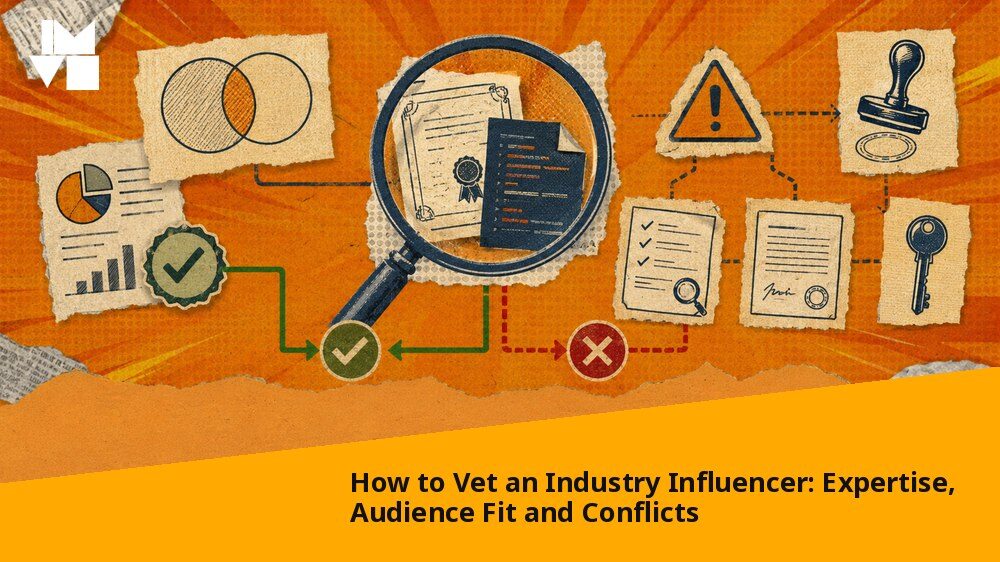
A profile with the right industry title can still be wrong for the campaign. Verify expertise, audience, claim history, commercial relationships, employer policy and ability to create the required asset before discussing fees.
Treat industry-influencer vetting as due diligence on a professional voice. The closer the content sits to a buying decision or regulated category, the clearer the checks need to be.
Verify credentials through evidence, not the bio
Cross-check work history, speaking topics, published material, questions the person answers and how industry peers respond. When an expert presents data or technical claims, find the source and see whether they preserve the conditions and limitations.
Credentials do not always mean degrees. For operators and specialist streamers, a history of demonstrations, error handling and the quality of community questions may be stronger practical evidence.
Check audience fit at the role level
Follower location and age are not enough for B2B. Review job titles, companies, commenters, guests, community overlap and the topics that create useful discussion. A small audience of installers, resellers or category managers may be more relevant than broad reach.
When direct data is unavailable, label the audience match as a hypothesis and test it in a pilot. Do not present inferred audience composition as a verified claim.
Ask about conflicts before writing the brief
Check the current employer, distributors or vendors under contract, competing clients, association positions and exclusivity commitments. A distributor employee may know the category well but lack permission to speak or promote outside the company.
The US FTC disclosure guidance treats employment and financial relationships as material connections that should be made obvious in an endorsement. It is US guidance, not a substitute for local legal review; the useful operating principle is to examine and disclose any relationship that could change how the audience evaluates the message.
An industry-influencer vetting scorecard
Keep both the score and the underlying evidence. A high total cannot cancel a blocker such as an unsupported claim, employer refusal or direct conflict with a competing brand.
Resolve blockers before moving a candidate into the commercial shortlist.

| Criterion | Evidence to review | Decision question | Red flag |
|---|---|---|---|
| Expertise | Work history, content, sources | Do they stay in scope? | Unsourced claims |
| Audience fit | Roles, companies, communities | Do they reach actual buyers? | Off-category audience |
| Content fit | Demos, talks, formats | Can they create the asset? | Only reads a script |
| Conflict | Employer, deals, exclusivity | Are they allowed to work? | Undisclosed relationship |
| Operations | Timing, approval, rights | Can they deliver the scope? | Unclear usage rights |
Lock claims, approval and rights in the contract
State deliverables, platform, production date, review rounds, claim sources, disclosure, editing permission, usage rights, paid media, territory, term and exclusivity. For employees of another company, keep evidence of employer approval where required.
The choice between direct booking and a local agency also affects the contracting route, documentation and owner for handling changes.
How IMVN organises vetting and shortlisting
IMVN can take a buyer question, source profiles by role, record credential sources, review public content, check audience signals, ask about conflicts and employer approval, then present a shortlist with risk notes. Availability and fees are confirmed after the content scope is clear.
Vetting should return to the industry influence map: every person needs to address a defined question, or they remain only a name that appears relevant.
Planning a similar creator campaign?
Share your market, category and objective. IMVN will respond with practical recommendations for the next step.
Request campaign advice →