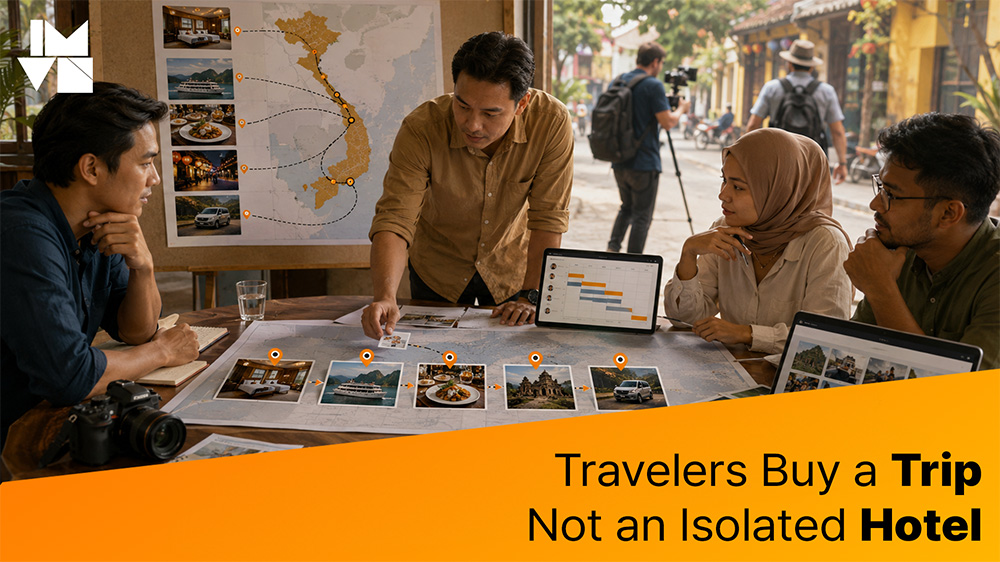


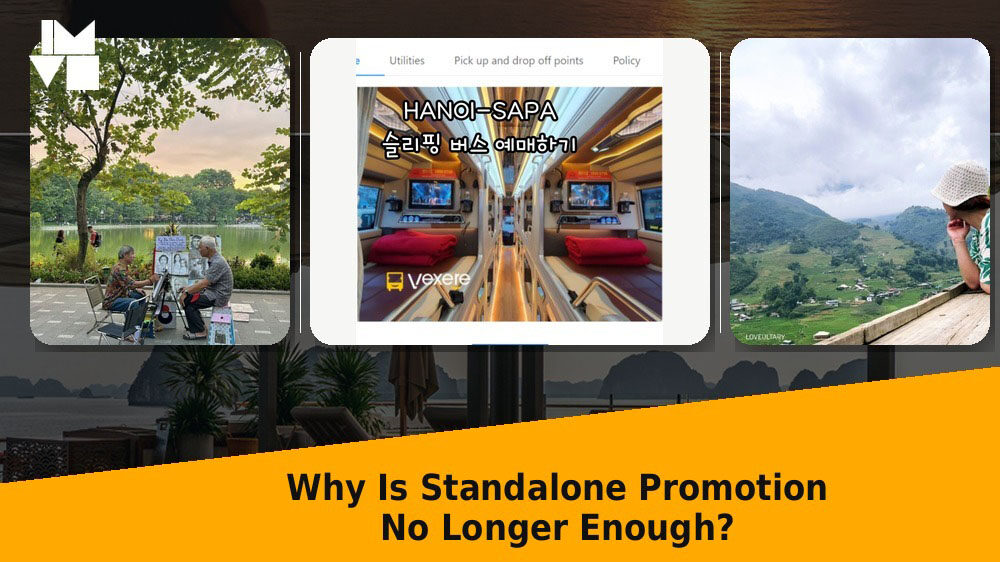
Korean travelers do not search for your cruise or resort first. They search for an itinerary.
A practical perspective for Vietnamese tourism businesses approaching the Korean market
More than 4.6 million Korean visitors came to Vietnam in 2024, making Korea the country’s largest source market. Searches for the keyword “Vietnam” on Naver increased 260% in 2023 and continued to grow through 2024–2025.
Yet no matter how attractive a resort is or how luxurious a cruise may be, to a Korean traveler who has never visited Vietnam, it does not initially exist as an independent brand. It exists as part of an itinerary. Travelers do not search for a resort name first. They search for “하노이 여행코스” (Hanoi itinerary), “하롱베이 크루즈 추천” (recommended Ha Long cruises), or “사파 숙소” (Sa Pa accommodation), and only then move on to specific names.
This means that if your brand does not appear in that itinerary context, it can be excluded before the real comparison even begins. Not because the service is poor, but because travelers do not know the brand exists at the point where they need it.
Standalone marketing spend: high cost, limited combined impact
Many tourism businesses currently run their own ads, hire individual KOLs, and produce their own content, yet the outcome does not match the spend. The issue is not necessarily poor content or the wrong KOL. The issue is that one brand on its own cannot create the full “itinerary ecosystem” Korean travelers are looking for.
When Korean travelers plan a trip to northern Vietnam, they look for an end-to-end journey:
- Where should they stay in Hanoi?
- Which cruise should they take in Ha Long?
- Which resort should they choose in Sa Pa?
- What should they eat?
- How should they move between destinations?
They want to see the whole route, not isolated stops. A Sa Pa resort review can be far more effective when it sits inside a five-day Hanoi – Ha Long – Sa Pa itinerary rather than standing alone.
Travelers do not book a resort. They book a trip. The brand that can place itself naturally inside that trip gains the advantage.
Strategy: Place the brand inside itineraries Korean travelers already use
Instead of creating demand from zero, which is expensive and time-consuming, a more efficient approach is to build around itineraries that already exist in Korean travel behavior and place the brand at the point where it naturally belongs.
Strategy 1: Build around an established Hanoi – Ha Long – Sa Pa itinerary
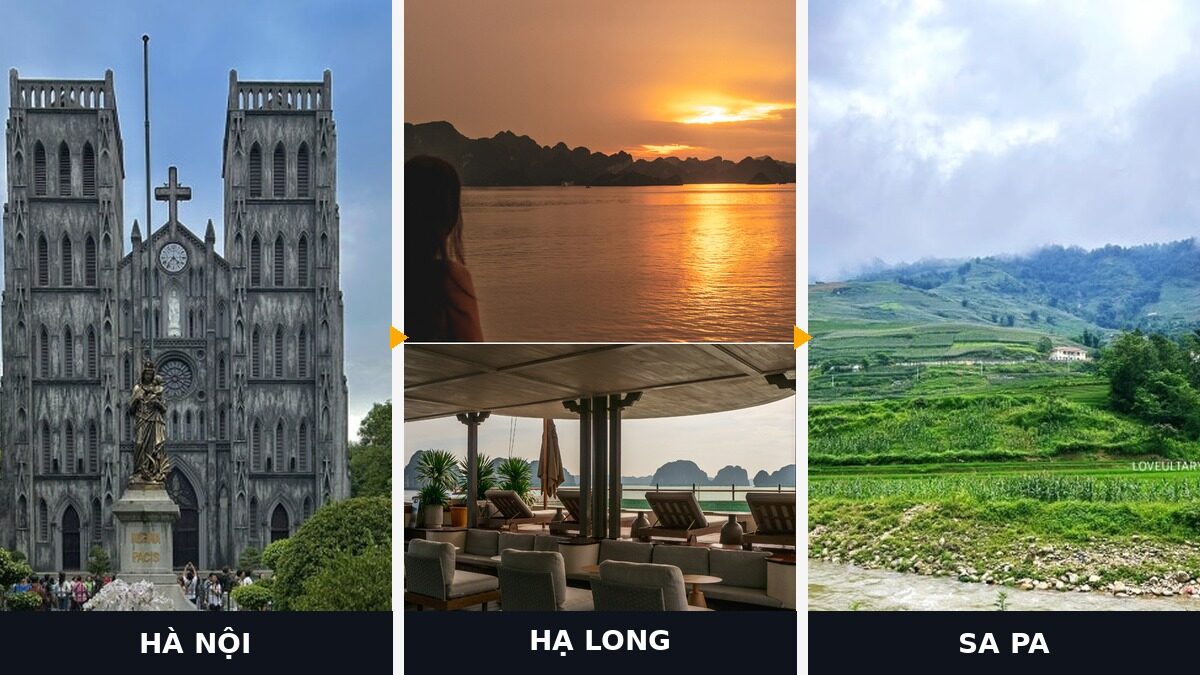
These three destinations form the most common northern Vietnam itinerary for Korean travelers. On Naver, search volume is distributed in this order: Hanoi is highest and acts as the “hub” connecting the trip, Ha Long is mid-level but stable throughout the year, and Sa Pa is smaller but growing the fastest. This reflects younger Korean travelers’ growing interest in nature and “healing” experiences away from cities.
The important point is that most northern Vietnam itineraries are planned by starting with the keyword “하노이여행” (Hanoi travel), then adding Ha Long or Sa Pa afterward.
Appearing in content about the full route, rather than promoting only one destination, helps a brand reach people who already have real travel intent and are actively making decisions. This audience has a much higher likelihood of converting to booking than people who have not yet formed a travel plan.
Strategy 2: Extend a familiar itinerary into a less-known destination
The second strategy suits destinations that are still less familiar in Korea but are located near an established destination. Instead of spending heavily to build awareness from the beginning, tourism businesses can position themselves as a “natural extension” of an itinerary travelers already know.
Da Nang is a useful example. It receives millions of Korean visitors each year thanks to dense direct-flight capacity and high awareness. Quy Nhon is only about five hours away, yet it has not captured the same flow of Korean travelers despite its relatively unspoiled beaches, clear water, and five-star resorts at noticeably more accessible prices than Da Nang.
Among younger Korean independent travelers, a group that accounted for more than 82% of Korean arrivals to Vietnam in 2025, this is the type of “hidden gem” that can appeal strongly when introduced in the right context. An influencer can create a new itinerary such as: “Add two days from Da Nang to explore unspoiled Quy Nhon,” turning an unfamiliar destination into a place worth considering.
There is no need to compete directly with Da Nang. The opportunity is to attach the destination to a Da Nang itinerary as an attractive additional experience.
Why does this strategy need collaboration rather than one brand working alone?
Both strategies have one thing in common: they require content about a complete itinerary, not isolated content about individual destinations. To produce that complete journey, multiple tourism businesses need to participate in the same route.
If a Korean KOL experiences a Ha Long cruise and then returns to Hanoi without visiting a Sa Pa resort, the resulting content only covers part of the itinerary. When one trip produces content across Hanoi – Ha Long – Sa Pa, the KOL can create a complete itinerary story that travels further, is searched more often, and gives every participating brand exposure through the wider journey.
Each stop still needs a reason to be chosen within the wider trip. For cruise operators, the article on distinctive Ha Long cruise experiences explores that part of the work.
This is the kind of collaborative approach that major destinations such as Japan and Thailand have used successfully with the Korean market since 2022–2023. Instead of each hotel or tour operator creating isolated content, businesses combine resources, host KOLs on a complete journey, and build a content ecosystem that covers the full set of search keywords.
So instead of booking one KOL for a standalone review, it is more logical to design the campaign around a route: multiple pieces of content built around a journey travelers are already searching for, with each brand appearing at the point where it plays a real role in the trip.
For the Sa Pa stop, appearing in an itinerary is only the beginning. Businesses also need to address the doubts that keep Korean travelers from booking.
That is also how we design the Korean Creator Campaign for the Hanoi – Ha Long route.
References: Korea Tourism Organization (2025) · Naver Corporation Vietnam Data (April 2025) · Expedia Traveler Value Index (2025) · Vietnam National Authority of Tourism · VietnamPlus — Vietnamese destinations attracting Korean visitors (2026) · B-Company Japan Research: Vietnam travel trends (2025)
Planning a similar creator campaign?
Share your market, category and objective. IMVN will respond with practical recommendations for the next step.
Request campaign advice →